Request Free Sample ×

Kindly complete the form below to receive a free sample of this Report

* Please use a valid business email

Leading companies partner with us for data-driven Insights

clients tt-cursor
Hero Background

Smart Irrigation Market

ID: MRFR/SEM/1889-CR
174 Pages
Ankit Gupta
Last Updated: March 31, 2026

Smart Irrigation Market Size, Share and Research Report By Component (Controllers, Sensors, Water Flow Meters, Others), By System Type (Weather Based Controller Systems and Sensor Based Controller Systems), By Application (Agricultural {Green house, Open Field}, Non-Agricultural {Residential, Turf and Landscape, Golf Courses, Others}), By Region (North America, Asia Pacific, Europe, Rest of the World)) – Industry Forecast Till 2035

Share:
Download PDF ×

We do not share your information with anyone. However, we may send you emails based on your report interest from time to time. You may contact us at any time to opt-out.

Smart Irrigation Market Infographic
Purchase Options

Smart Irrigation Market Summary

As per Market Research Future analysis, the Smart Irrigation Market Size was estimated at 1980.93 USD Million in 2024. The Smart Irrigation industry is projected to grow from USD 2264.21 Million in 2025 to USD 8617.44 Million by 2035, exhibiting a compound annual growth rate (CAGR) of 14.3% during the forecast period 2025 - 2035

Key Market Trends & Highlights

The Smart Irrigation Market is poised for substantial growth driven by technological advancements and sustainability initiatives.

  • North America remains the largest market for smart irrigation solutions, reflecting a strong demand for efficient water management.
  • Asia-Pacific is emerging as the fastest-growing region, propelled by increasing agricultural activities and urbanization.
  • Controllers, particularly weather-based systems, dominate the market, while sensor-based systems are rapidly gaining traction.
  • Rising water scarcity and advancements in IoT technology are key drivers fueling the adoption of smart irrigation solutions.

Market Size & Forecast

2024 Market Size 1980.93 (USD Million)
2035 Market Size 8617.44 (USD Million)
CAGR (2025 - 2035) 14.3%

Major Players

Rain Bird Corporation (US), Hunter Industries (US), Netafim (IL), Toro Company (US), Valmont Industries (US), Lindsay Corporation (US), Jain Irrigation Systems (IN), Galcon (IL), Rivulis Irrigation (IL), HydroPoint Data Systems (US)

Our Impact
Enabled $4.3B Revenue Impact for Fortune 500 and Leading Multinationals
Partnering with 2000+ Global Organizations Each Year
30K+ Citations by Top-Tier Firms in the Industry

Smart Irrigation Market Trends

The Smart Irrigation Market is currently experiencing a notable transformation driven by advancements in technology and increasing awareness of sustainable agricultural practices. As water scarcity becomes a pressing global issue, the demand for efficient irrigation solutions is on the rise. Smart irrigation systems, which utilize sensors, weather data, and automated controls, are gaining traction among farmers and agricultural businesses, including ag irrigation companies and agriculture irrigation companies. These systems not only optimize water usage but also enhance crop yield and reduce operational costs. The integration of Internet of Things (IoT) technology further facilitates real-time monitoring and management, allowing for precise irrigation tailored to specific crop needs. Solutions such as hunter flow meter and wireless monitoring devices and rain bird rain sensor technologies exemplify this advancement. Moreover, the Smart Irrigation Market is witnessing a shift towards eco-friendly practices, as stakeholders recognize the importance of conserving water resources. Governments and organizations are increasingly promoting policies that encourage the adoption of smart irrigation technologies, benefiting agricultural irrigation manufacturers, irrigation startups, and emerging irrigation company names entering the market. This trend is likely to foster innovation and investment in the sector, leading to the development of more sophisticated solutions and irrigation business software platforms. Overall, the smart irrigation market is poised for growth, driven by the dual imperatives of efficiency and sustainability.

Technological Advancements

The Smart Irrigation Market is significantly influenced by rapid technological innovations. The emergence of IoT devices and advanced sensors enables farmers to monitor soil moisture levels and weather conditions in real-time. This capability allows for more precise irrigation scheduling, which can lead to improved water conservation and enhanced crop productivity. These advancements are increasingly adopted across the smart industry and by irrigation equipment manufacturers.

Sustainability Focus

There is a growing emphasis on sustainable agricultural practices within the Smart Irrigation Market. Stakeholders are increasingly aware of the environmental impact of traditional irrigation methods. As a result, there is a shift towards adopting smart irrigation solutions that promote water efficiency and reduce waste, aligning with global sustainability goals and supporting the growth of industrial irrigation system deployments.

Government Initiatives

Government policies and initiatives play a crucial role in shaping the Smart Irrigation Market. Many countries are implementing regulations and incentives to encourage the adoption of smart irrigation technologies. These efforts aim to support farmers in transitioning to more efficient practices, ultimately contributing to better resource management and agricultural resilience across both commercial and industrial irrigation system installations.

Smart Irrigation Market Drivers

Rising Water Scarcity

The increasing prevalence of water scarcity is a critical driver for the Smart Irrigation Market. As populations grow and climate change exacerbates drought conditions, the demand for efficient water management solutions intensifies. Smart irrigation systems, which utilize sensors and data analytics, can optimize water usage, thereby addressing the urgent need for sustainable practices. Reports indicate that agricultural water use accounts for approximately 70% of global freshwater withdrawals, highlighting the potential for smart irrigation technologies to significantly reduce this figure. By implementing these systems, farmers can conserve water while maintaining crop yields, making them an attractive option in regions facing severe water shortages.

Advancements in IoT Technology

The rapid advancements in Internet of Things (IoT) technology are propelling the Smart Irrigation Market forward. IoT-enabled devices allow for real-time monitoring and control of irrigation systems, leading to enhanced efficiency and reduced operational costs. These technologies facilitate data collection on soil moisture, weather conditions, and plant health, enabling farmers to make informed decisions. The market for IoT in agriculture is projected to reach substantial figures, indicating a growing acceptance of smart solutions in farming practices. As more stakeholders recognize the benefits of integrating IoT into irrigation, the demand for smart irrigation systems is likely to surge, transforming traditional agricultural methods.

Government Support and Incentives

Government initiatives and incentives aimed at promoting sustainable agricultural practices are a vital driver for the Smart Irrigation Market. Many governments are implementing policies that encourage the adoption of water-efficient technologies, including smart irrigation systems. These initiatives often include financial incentives, grants, and subsidies to support farmers in transitioning to more sustainable practices. As a result, the market for smart irrigation is likely to experience growth as farmers take advantage of these opportunities. Furthermore, regulatory frameworks that mandate water conservation practices are expected to further stimulate demand for smart irrigation solutions, aligning with broader environmental goals.

Increased Adoption of Precision Agriculture

The shift towards precision agriculture is significantly influencing the Smart Irrigation Market. Farmers are increasingly adopting precision farming techniques to enhance productivity and sustainability. Smart irrigation systems play a pivotal role in this transition by providing targeted water application based on specific crop needs. This approach not only conserves water but also improves crop quality and yield. Market data suggests that the precision agriculture market is expected to witness substantial growth, driven by the need for efficient resource management. As farmers seek to optimize their operations, the integration of smart irrigation technologies becomes essential, further propelling market expansion.

Growing Awareness of Environmental Sustainability

The increasing awareness of environmental sustainability among consumers and businesses is shaping the Smart Irrigation Market. As stakeholders recognize the importance of conserving natural resources, there is a growing demand for technologies that promote sustainable agricultural practices. Smart irrigation systems, which optimize water usage and reduce waste, align with these sustainability goals. Market trends indicate that consumers are increasingly favoring products sourced from environmentally responsible practices, prompting farmers to adopt smart irrigation solutions. This shift not only enhances the market appeal of agricultural products but also contributes to the overall sustainability of farming operations, driving further adoption of smart irrigation technologies.

Market Segment Insights

By Component: Controllers (Largest) vs. Sensors (Fastest-Growing)

In the Smart Irrigation Market, the component segment is primarily composed of controllers, sensors, water flow meters, and others. Controllers dominate this segment, capturing the largest share due to their role in automating irrigation practices and optimizing water usage. Sensors, on the other hand, are witnessing rapid adoption, driven by an increasing need for precision agriculture and real-time data monitoring. As smart technologies evolve, both segment values contribute significantly to market growth, with controllers established as leaders, while sensors are recognized for their unprecedented growth trajectories.

Controllers (Dominant) vs. Sensors (Emerging)

Controllers are the dominant component in the Smart Irrigation Market, mainly due to their capability to manage irrigation schedules, ensuring optimal water distribution based on specific needs. They integrate advanced technologies, enhancing user accessibility and efficiency. Sensors, categorized as emerging components, are increasingly recognized for their importance in capturing soil moisture levels, weather conditions, and crop requirements. This real-time data empowers farmers to make informed decisions, leading to water conservation and improved crop yields. Their growth is fueled by technological advancements and the push for sustainable agricultural practices.

By System Type: Weather-Based Controller Systems (Largest) vs. Sensor-Based Controller Systems (Fastest-Growing)

The market for smart irrigation systems is primarily dominated by weather-based controller systems, which offer greater functionality and efficiency by adjusting irrigation schedules based on real-time weather data. This segment has captured a significant portion of the market share as users prioritize reliable solutions that optimize water usage while ensuring plant health. Conversely, sensor-based controller systems are emerging rapidly due to advancements in technology, allowing for precise moisture monitoring and tailored irrigation practices catering to specific landscape needs.

System Type: Weather-Based (Dominant) vs. Sensor-Based (Emerging)

Weather-based controller systems are firmly established as the dominant force within the smart irrigation market, largely due to their ability to enhance water conservation and improve crop yield efficiency. These systems utilize predictive algorithms that adjust watering schedules according to meteorological data, ensuring optimal irrigation levels. On the other hand, sensor-based controller systems are identified as emerging technologies that provide real-time monitoring of soil moisture conditions, enabling targeted irrigation. This segment is gaining traction as environmental awareness rises, driving demand for efficient water usage solutions. Together, these system types represent a pivotal evolution in irrigation practices, balancing traditional methods with innovative approaches.

By Application: Agricultural (Largest) vs. Non-Agricultural (Fastest-Growing)

The Smart Irrigation Market is significantly influenced by the application segments of Agricultural and Non-Agricultural uses. The Agricultural segment, which includes precision farming and crop irrigation, holds the largest share of the market. Farmers are increasingly adopting smart irrigation systems to optimize water usage and enhance crop yields, pushing this segment to the forefront of the market. On the other hand, the Non-Agricultural segment, comprising residential and commercial applications, is growing rapidly. The rising need for water conservation in urban areas is propelling the adoption of smart irrigation solutions among homeowners and landscape managers, making this segment one of the fastest-growing in the industry.

Application: Agricultural (Dominant) vs. Non-Agricultural (Emerging)

The Agricultural application of smart irrigation represents a dominant force in the market, primarily due to the emphasis on sustainable farming practices and the need for efficient water management. Advanced irrigation technologies, such as drip and sprinkler systems, are widely implemented by farmers to reduce water wastage and ensure optimal crop health. In contrast, the Non-Agricultural application is an emerging segment that is rapidly gaining traction. With growing awareness about environmental sustainability, urban homeowners and commercial property managers are integrating smart irrigation systems into their landscaping practices. The increasing adoption of IoT and sensor-based technologies in non-agricultural settings is driving this segment's growth, enabling better resource management and enhancing the aesthetic appeal of outdoor spaces.

Get more detailed insights about Smart Irrigation Market

Regional Insights

North America : Technological Innovation Leader

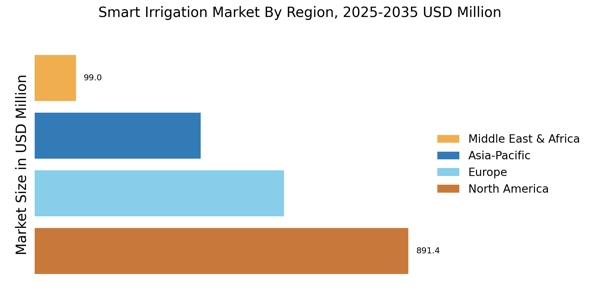
North America is the largest market for smart irrigation, holding approximately 45% of the global share. The region benefits from strong adoption by leading irrigation equipment manufacturers, such as Hunter Industries Incorporated Irrigation, Toro Irrigation Company, and Rain Bird Corporation. These companies support a mature ecosystem of irrigation system brands and advanced monitoring technologies. The demand for efficient irrigation solutions is further fueled by the agricultural sector's need to optimize water usage and reduce costs. The United States is the leading country in this market, with significant contributions from states like California and Texas, where water conservation is critical. Key players such as Rain Bird Corporation, Hunter Industries, and Toro Company dominate the landscape, driving innovation and competition. The presence of these companies ensures a robust supply chain and a variety of smart irrigation solutions available to consumers.

Europe : Sustainability Focused Market

Europe is witnessing a growing demand for smart irrigation solutions, driven by sustainability initiatives and regulatory support. Established irrigation manufacturers and solution providers continue to expand their footprint across the region. Regulatory frameworks, such as the EU Water Framework Directive, encourage efficient water use and promote smart irrigation practices across member states. Leading countries in this market include Germany, France, and the Netherlands, where innovative agricultural practices are prevalent. The competitive landscape features key players like Netafim and Galcon, who are actively developing cutting-edge solutions tailored to European needs. The emphasis on sustainability and regulatory support positions Europe as a significant player in the smart irrigation market.

Asia-Pacific : Emerging Market Potential

Asia-Pacific is an emerging powerhouse in the smart irrigation market, driven by agricultural modernization and the presence of domestic agriculture irrigation companies and ag irrigation companies, particularly in India and China. Countries like India and China are at the forefront, implementing policies to enhance water efficiency in agriculture. India, in particular, is witnessing a surge in smart irrigation adoption, supported by local players like Jain Irrigation Systems. The competitive landscape is evolving, with both domestic and international companies vying for market share. The region's diverse agricultural practices and growing awareness of water conservation are key factors driving the demand for smart irrigation solutions.

Middle East and Africa : Resource-Constrained Region

The Middle East and Africa region faces water scarcity challenges, accelerating the adoption of smart irrigation technologies by governments and private players, including industrial irrigation system developers and regional irrigation company names. Initiatives aimed at improving agricultural efficiency and water management are key drivers of market growth. Countries like Israel and South Africa are leading the way in implementing smart irrigation solutions. Israel, known for its advanced agricultural technologies, is home to key players like Rivulis Irrigation and Galcon. The competitive landscape is characterized by a mix of local and international companies striving to address the region's unique challenges. The focus on water security and sustainable practices is expected to drive further growth in the smart irrigation market.

Smart Irrigation Market Regional Image

Key Players and Competitive Insights

With a strong presence across different verticals and geographies, the Smart Irrigation Market is highly competitive and dominated by established, pure-play vendors. Over 14 vendors cater to this market, and they continually innovate their solutions to meet the evolving needs of businesses by adopting new technologies to make business more effective. These vendors have a robust geographic footprint and partner ecosystem to cater to diverse customer segments. The Smart Irrigation Market is highly competitive, with many vendors offering similar products and services.The major players in the market include The Toro Company, Netafim, Hunter Industries, Rain Bird Corporation, HydroPoint, Rachio, Banyan Water, RainMachine - Green Electronics LLC, ET Water (Jain Irrigation, Inc.), Galcon, Weathermatic, Skydrop, Delta-T Devices, The Scotts Miracle-Gro. The Smart Irrigation Market is a consolidated market due to increasing competition, acquisitions, mergers, and other strategic market developments and decisions to improve operational effectiveness.

Key Companies in the Smart Irrigation Market include

Industry Developments

  • Industry developments continue to strengthen the Smart Irrigation Market, with innovation driven by established vendors and irrigation startups offering data-driven platforms, automation, and analytics.

  • In June 2022, Banyan Water launched its mobile app, catering to landscapers and irrigation professionals. The app provides geolocation, detailed irrigation maps, and real-time control, allowing users to manage water flow, access historical data, and optimize irrigation for new plantings.
  • In January 2023, Denver startup Rachio introduced a smart timer for garden hoses, complementing its focus on efficient water use. The device connects to outdoor faucets, features Wi-Fi control via smartphones, and includes a patented flow meter, enhancing sustainability in lawn care.

Future Outlook

Smart Irrigation Market Future Outlook

The Smart Irrigation Market is projected to grow at a 14.3% CAGR from 2025 to 2035, driven by technological advancements, water scarcity concerns, and increasing agricultural efficiency demands.

New opportunities lie in:

  • Integration of AI-driven analytics for predictive irrigation management.
  • Development of mobile applications for real-time irrigation monitoring.
  • Partnerships with agricultural tech firms for bundled smart solutions.

By 2035, the Smart Irrigation Market is expected to be robust, driven by innovation and sustainability.

Market Segmentation

Smart Irrigation Market Component Outlook

  • controllers
  • sensors
  • water flow meters
  • others

Smart Irrigation Market Application Outlook

  • Agricultural
  • Non Agricultural

Smart Irrigation Market System Type Outlook

  • weather-based controller systems
  • sensor-based controller systems

Report Scope

MARKET SIZE 2024 1980.93(USD Million)
MARKET SIZE 2025 2264.21(USD Million)
MARKET SIZE 2035 8617.44(USD Million)
COMPOUND ANNUAL GROWTH RATE (CAGR) 14.3% (2025 - 2035)
REPORT COVERAGE Revenue Forecast, Competitive Landscape, Growth Factors, and Trends
BASE YEAR 2024
Market Forecast Period 2025 - 2035
Historical Data 2019 - 2024
Market Forecast Units USD Million
Key Companies Profiled Rain Bird Corporation (US), Hunter Industries (US), Netafim (IL), Toro Company (US), Valmont Industries (US), Lindsay Corporation (US), Jain Irrigation Systems (IN), Galcon (IL), Rivulis Irrigation (IL), HydroPoint Data Systems (US)
Segments Covered Component, System Type, Application, Region
Key Market Opportunities Integration of advanced sensors and data analytics enhances efficiency in the Smart Irrigation Market.
Key Market Dynamics Technological advancements drive adoption of smart irrigation systems, enhancing water efficiency and sustainability in agriculture.
Countries Covered North America, Europe, APAC, South America, MEA

Market Highlights

FAQs

What is the current valuation of the Smart Irrigation Market as of 2024?

The Smart Irrigation Market was valued at approximately 1980.93 USD Million in 2024.

What is the projected market valuation for the Smart Irrigation Market in 2035?

The market is projected to reach approximately 8617.44 USD Million by 2035.

What is the expected CAGR for the Smart Irrigation Market during the forecast period 2025 - 2035?

The expected CAGR for the Smart Irrigation Market during the forecast period 2025 - 2035 is 14.3%.

Which companies are considered key players in the Smart Irrigation Market?

Key players in the Smart Irrigation Market include Rain Bird Corporation, Hunter Industries, Netafim, and Toro Company.

What are the main components of the Smart Irrigation Market and their valuations?

The main components include controllers valued at 1740.0 USD Million, sensors at 2570.0 USD Million, and water flow meters at 1285.0 USD Million.

How do system types in the Smart Irrigation Market compare in terms of valuation?

Weather-based controller systems are valued at 3482.25 USD Million, while sensor-based controller systems are valued at 5135.19 USD Million.

What applications dominate the Smart Irrigation Market?

The agricultural application dominates with a valuation of 5150.0 USD Million, compared to 3467.44 USD Million for non-agricultural applications.

What trends are influencing the growth of the Smart Irrigation Market?

Trends such as increased water conservation efforts and technological advancements in irrigation systems are influencing market growth.

How does the Smart Irrigation Market's growth potential compare to other sectors?

The Smart Irrigation Market's growth potential appears robust, with a projected valuation increase from 1980.93 USD Million in 2024 to 8617.44 USD Million by 2035.

What role do companies like Valmont Industries and Jain Irrigation Systems play in the market?

Companies like Valmont Industries and Jain Irrigation Systems contribute significantly to innovation and market expansion within the Smart Irrigation sector.
Author
Author
Author Profile
Ankit Gupta LinkedIn
Team Lead - Research
Ankit Gupta is a seasoned market intelligence and strategic research professional with over six plus years of experience in the ICT and Semiconductor industries. With academic roots in Telecom, Marketing, and Electronics, he blends technical insight with business strategy. Ankit has led 200+ projects, including work for Fortune 500 clients like Microsoft and Rio Tinto, covering market sizing, tech forecasting, and go-to-market strategies. Known for bridging engineering and enterprise decision-making, his insights support growth, innovation, and investment planning across diverse technology markets.
Leave a Comment

Research Approach

Secondary Research

The secondary research process involved comprehensive analysis of regulatory databases, agricultural technology publications, peer-reviewed journals, irrigation industry reports, and authoritative agricultural and environmental organizations. Key sources included the United States Department of Agriculture (USDA), Environmental Protection Agency (EPA) WaterSense Program, Food and Agriculture Organization (FAO) of the United Nations, International Commission on Irrigation and Drainage (ICID), Irrigation Association (IA), European Environment Agency (EEA), European Commission Agriculture and Rural Development, Bureau of Indian Standards (BIS) Agricultural Division, National Institute of Hydrology (India), China Ministry of Water Resources, Israeli Ministry of Agriculture and Rural Development, USDA National Agricultural Statistics Service (NASS), United States Geological Survey (USGS) Water Resources, World Bank Climate Change Knowledge Portal, International Water Management Institute (IWMI), and national agricultural ministry reports from key markets. These sources were used to collect irrigation statistics, technology adoption rates, water usage data, regulatory compliance requirements, and precision agriculture trends for weather-based systems, sensor-based controllers, soil moisture sensors, and smart flow meter technologies.

Primary Research

Qualitative and quantitative insights were obtained by interviewing supply-side and demand-side stakeholders during the primary research process. CEOs, VPs of Product Development, Chief Technology Officers, and directors of Agricultural Solutions from smart irrigation equipment manufacturers, precision agriculture technology providers, and IoT sensor OEMs are among the supply-side sources. The demand-side sources included procurement leads from agricultural enterprises, municipal water authorities, and commercial turf management companies, as well as large-scale farm operators, agricultural cooperative managers, golf course superintendents, commercial landscaping directors, and greenhouse facility managers. The primary research validated market segmentation across controller technologies and sensor systems, confirmed product development pipelines, and garnered insights on adoption barriers, pricing dynamics, water policy impacts, and integration challenges with existing irrigation infrastructure.

Primary Respondent Breakdown:

By Designation: C-level Primaries (28%), Director Level (35%), Others (37%)

By Region: North America (32%), Europe (30%), Asia-Pacific (33%), Rest of World (5%)

Market Size Estimation

Global market valuation was derived through revenue mapping and installation volume analysis across agricultural and non-agricultural segments. The methodology included:

Identification of 50+ key manufacturers and technology providers across North America, Europe, Asia-Pacific, Middle East, and Latin America

Product mapping across weather-based controllers, sensor-based controllers, soil moisture sensors, rain/freeze sensors, smart water flow meters, and integrated IoT irrigation platforms

Analysis of reported and modeled annual revenues specific to smart irrigation product portfolios

Coverage of manufacturers representing 75-80% of global market share in 2024

Extrapolation using bottom-up (installation volume × ASP by application and region) and top-down (manufacturer revenue validation) approaches to derive segment-specific valuations for greenhouse automation, open-field precision agriculture, residential smart home integration, and commercial turf management sectors

Download Free Sample

Kindly complete the form below to receive a free sample of this Report

Compare Licence

×
Features License Type
Single User Multiuser License Enterprise User
Price $4,950 $5,950 $7,250
Maximum User Access Limit 1 User Upto 10 Users Unrestricted Access Throughout the Organization
Free Customization
Direct Access to Analyst
Deliverable Format
Platform Access
Discount on Next Purchase 10% 15% 15%
Printable Versions